
28
Luglio
2026
|
08:38
Europe/Amsterdam
Advancing its product launch programme, Mercedes-Benz Cars performs in line with guidance; strong earnings at Financial Services and Vans; full-year outlook confirmed
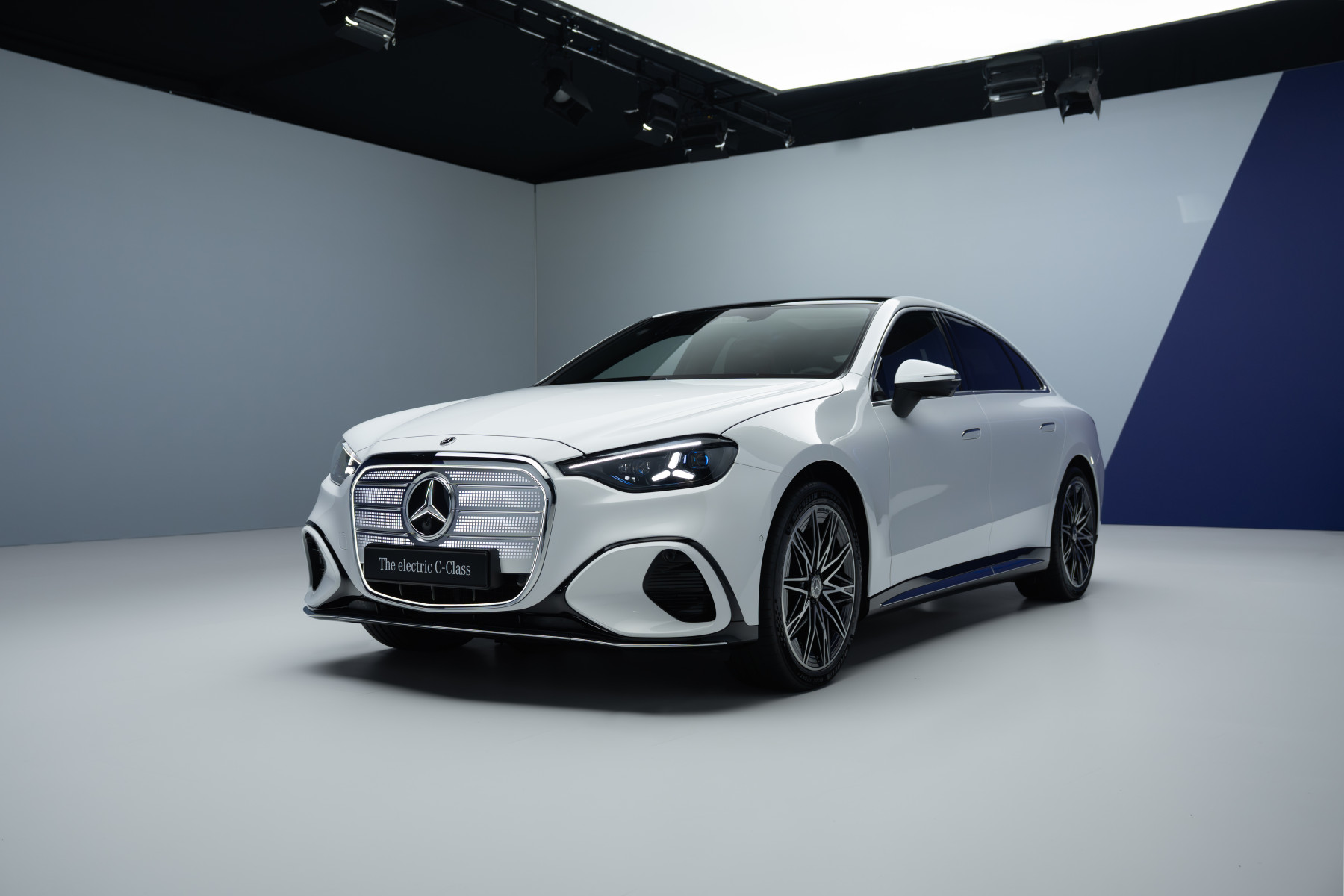
26C0063_050
Der neue Mercedes-Benz C 400 4MATIC elektrisch. Energieverbrauch kombiniert: 18,6-14,2 kWh/100 km | CO₂-Emissionen kombiniert: 0 g/km | CO₂-Klasse: A [1] Exterieur: AMG Line; MANUFAKTUR opalithweiß metallic bright [1] Die Angaben sind vorläufig. Es liegen bislang weder bestätigte Werte von einer amtlich anerkannten Prüforganisation noch eine EG-Typgenehmigung noch eine Konformitätsbescheinigung mit amtlichen Werten vor. Abweichungen zwischen den Angaben und den amtlichen Werten sind möglich.;Energieverbrauch kombiniert: 18,6-14,2 kWh/100 km | CO₂-Emissionen kombiniert: 0 g/km | CO₂-Klasse: A * The all-new Mercedes-Benz C 400 4MATIC electric. Energy consumption combined: 18,6-14,2 kWh/100 km | CO₂ emissions combined: 0 g/km | CO₂ class: A [1] Exterior: AMG Line; MANUFAKTUR opalithe white bright [1] The information is provisional. Neither confirmed values from an officially recognised testing organisation nor an EC type approval nor a certificate of conformity with official values are available to date. Deviations between the data and the official values are possible.;Energy consumption combined: 18,6-14,2 kWh/100 km | CO₂ emissions combined: 0 g/km | CO₂ class: A*
Riepilogo
- Mercedes-Benz Cars: adjusted return on sales of 4.0% within guidance; reported return on sales reflecting intensified market environment in China and macroeconomic headwinds
- Product launch momentum builds: Mercedes-Benz Cars BEV sales increased by 51% year-on-year, including growth of 87% in Europe
- Benchmark performance at Mercedes-Benz Vans: adjusted return on sales of 10.2% at the upper end of the guidance range; all-electric van sales rose by 46% year-on-year
- Strong Mercedes-Benz Financial Services results: adjusted EBIT increased by 70% year-on-year to €492 million, driven by higher portfolio margins and lower operating expenses; adjusted return on equity increased significantly to 15.3%
- Mercedes-Benz Group: EBIT increased to €1.5 billion; consistent cost discipline supported earnings; net liquidity remained strong at €30.4 billion at the end of the quarter; free cash flow of the industrial business amounted to €1.1 billion in Q2
- Full-year outlook: Guidance for Mercedes-Benz Cars adjusted return on sales confirmed; xEV share at Mercedes-Benz Cars now expected at 23% to 25%; Mercedes-Benz Cars unit sales and Group revenue now anticipated slightly below prior-year levels; guidance for adjusted return on equity for Financial Services increased to 12% to 14%; guidance for free cash flow of the industrial business, including mergers and acquisitions, confirmed
“Despite a demanding market environment, we remained on track in the second quarter while continuing to advance our product launch programme. Customer response to our new models is strong, with Mercedes-Benz Cars BEV sales up 51% and BEV order intake in Europe more than doubling in the quarter. In the second half, we will focus on bringing more new models to customers while further improving our cost position and productivity.”
Ola Källenius, Chairman of the Board of Management of Mercedes-Benz Group AG
Mercedes-Benz Group AG (ticker symbol: MBG) reported revenue of €32.1 billion in the second quarter (Q2 2025: €33.2 billion) and Group EBIT of €1.5 billion (Q2 2025: €1.3 billion), while continuing to execute its largest-ever product launch programme and further improving efficiency and productivity.
Group EBIT was supported by strong earnings at Mercedes-Benz Financial Services, Mercedes-Benz Vans and higher contributions from the Group reconciliation, partly offset by lower earnings at Mercedes-Benz Cars. Group EBIT also included a positive effect of €131 million related to the planned sale of Athlon Group. Adjusted Group earnings before interest and taxes reached €2.3 billion (Q2 2025: €2.0 billion).
Mercedes-Benz made further progress with its Next Level Performance (NLP) programme, with cost measures continuing to support earnings in the second quarter. At Group level, general administrative expenses decreased by 14%, and research and development expenditure declined by 12%, following last year’s investment peak for the Mercedes-Benz Cars product launch plan. At Mercedes-Benz Cars, cost of sales declined by 7%. Efficiency measures also supported the cost position at Mercedes-Benz Vans and Mercedes-Benz Financial Services. Building on a reduction in fixed costs of approximately 25% since 2019, the company began further intensifying its global productivity measures in June 2026, with a particular focus on its German locations.
Free cash flow of the industrial business amounted to €1.1 billion in the second quarter (Q2 2025: €1.9 billion), supported by proceeds of €417 million from the partial sale of the Daimler Truck shareholding. In the first half of 2026, free cash flow of the industrial business amounted to €3.0 billion (H1 2025: €4.2 billion), reflecting an outflow of approximately €1.1 billion for severance payments in connection with the Next Level Performance programme.
The company maintained a solid financial position amid macroeconomic headwinds and ongoing model ramp-ups. Following dividend payments and share repurchases totalling €5 billion in the first half of the year, net liquidity of the industrial business remained strong at €30.4 billion, while the funding ratio of the pension plans improved to 117% from 113% at year-end 2025.
Mercedes-Benz Cars
Mercedes-Benz Cars posted adjusted EBIT of €909 million in the second quarter (Q2 2025: €1,228 million), corresponding to an adjusted return on sales (RoS) of 4.0% (Q2 2025: 5.1%) and thus within the full-year guidance range of 3% to 5%. The year-on-year development reflected intensified market pressure, especially in China, a less favourable model mix, product lifecycle measures and launch-campaign-related costs, partly offset by continued efficiency gains.
Reported EBIT amounted to €49 million (Q2 2025: €783 million) and included impairments of €704 million in connection with Chinese equity-method investments. The effects did not result in a corresponding cash outflow in the second quarter and were excluded from adjusted EBIT. The Chinese market and customers in China remain of high strategic importance to Mercedes-Benz.
Mercedes-Benz continued to advance its largest-ever model launch programme, comprising more than 40 new models between 2025 and 2027. Mercedes-Benz Cars BEV sales increased by 51% year-on-year to 52,852 units in the second quarter (Q2 2025: 35,027 units), driven by growth of 87% in Europe. Overall, Mercedes-Benz Cars sold 417,765 vehicles in the second quarter (Q2 2025: 453,674 vehicles). Sales increased by 4% in Europe and by 10% in the United States. This partly offset a 30% sales decline in China, where intense competition, subdued demand and the portfolio-wide model changeover continued to affect sales. Excluding China, global car sales increased by 2% year-on-year.
The Top-End segment accounted for 13.9% of global sales in the second quarter. The share reached 14.3% in the first half of 2026, within the full-year target range of 14% to 15%.
The ramp-up of recently launched models is increasingly translating into sales, with the all-new CLA and GLB making a tangible contribution and high order volumes for the all-new electric GLC expected to support further deliveries in the second half of the year. The new S-Class has made a successful start in Europe, with more regions to follow in the coming months. Order books also opened for a broad range of further models, including the all-new electric C-Class, the new GLE and GLS and the Mercedes-AMG GLE 53 and GLC 53 model families. Further product highlights included the world premiere of the all-new Mercedes-AMG GT 4-Door Coupé variants and the debuts of the new Mercedes-Maybach GLS as well as the Mercedes-AMG GLE 63 S 4MATIC+ as SUV and Coupé and the Mercedes-AMG GLS 63 4MATIC+ SUV, all powered by new V8 engines. The model launch plan will continue with the world premiere and start of sales of the all-new electric GLA at the end of July. Following China and the United States, Mercedes-Benz is also targeting the introduction of point-to-point assisted driving in the first German cities by the end of 2026.
In July, Mercedes-Benz marked the expansion of its Kecskemét plant in Hungary. Investments of around €1 billion have doubled the site’s footprint and increased its production flexibility for electrified combustion-engine, plug-in hybrid and all-electric models. The plant is producing the all-new electric C-Class, the first all-electric Core model built at the site.