
23
Maggio
2011
|
02:00
Europe/Amsterdam
The Mercedes-Benz Unimog – the Success of an Idea
Unimog: A living legend
1951: Daimler-Benz starts its production line in Gaggenau
Unimog S model rolls of the line in 1955
Medium product range 406 follows in 1963
Its heavier brothers follow from 1974 on
1992: Main focus on all-year round operation for product
range 408/418New generation of implement carriers U 300 bis U 500 greets the new millenium
The current Unimog range
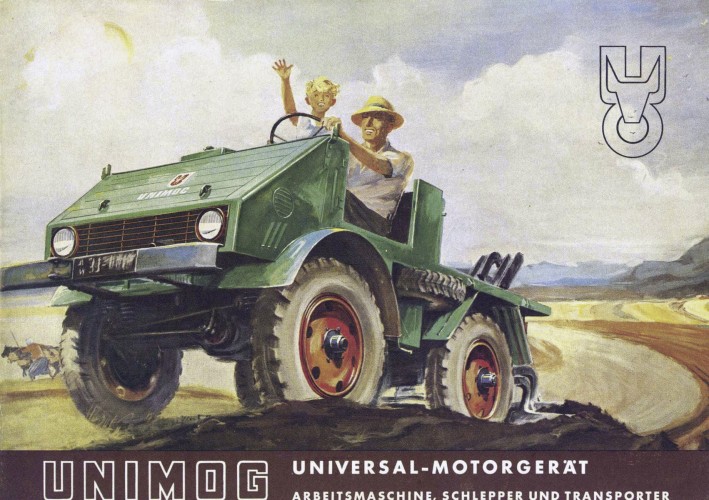
Created during the hard times immediately following the end of WW II, the tough Mercedes-Benz Unimog has long since become one of the few still-living legends of automobile construction. Over decades, the Unimog has proved itself worldwide as a versatile implement carrier and transport vehicle; up to the present day roughly 380,000 vehicles have been produced. What remains throughout is its basic idea: four wheels, equal in size, outstanding off-road mobility due to its portal axles, four-wheel drive and differential locks at front and back, compact dimensions and last but not least its ability to provide power for a great variety of attached and mounted implements.
First drawings crop up as early as 1945
The first drawings for an agricultural vehicle from the pen of Albert Friedrich, previously head of Daimler-Benz Aero Engine Construction, date back to autumn 1945. Friedrich gained the company Erhard & Sons in Schwäbisch Gmünd as a partner in research and development. The series production of the vehicle known as the "Universal-Motor-Gerät (tool)" – abbreviated to Unimog – started in 1948 at Boehringer Bros. Engineering Company in Göppingen. As the demand for the production run grew bringing with it a need for long-term investments, Daimler-benz took over the Unimog business in autumn 1950 and the new plant in Gaggenau started manufacturing the Unimog on 3 June 1951.
From May 1953 on, the Unimog proudly carried the Mercedes star and two years later, also in May, the first Unimog of the 404 product range rolled off the assembly line. Its chassis – which provided outstanding offroad mobility – was manufactured until 1980 and supplied to many countries all over the world.
An additional product range to satisfy growing demand
As demand grew and requirements became more and more complex and diverse, from 1962 on Daimler-Benz supplemented the Unimog with a larger product range referred to as the 406. Three years later this was succeeded by product range 416.
Further milestones in the history of the Unimog were product ranges 424 in 1974 and 435 in 1976 – and with them the advent of the heavy duty Unimog product ranges. May 1992 saw the introduction of product ranges 408 with the Unimog U 90 (lighter Unimog product range) and 418 with models U 110 and U 140 (medium-weight Unimog product range).
The current programme
Since 2000, public services, municipal contractors, the construction and energy sectors as well as other industries have been the main customers for Unimog implement carriers U 300, U 400 and U 500. Their striking looks with their practical and attractively-designed cabs made of fibre-reinforced composite material, their quick-change steering Vario-Pilot which can be transferred within seconds from left to right, the powerful new hydraulic system VarioPower and their current powerful engines with up to 210 Kw (286 hp) – allow the Unimog implement carriers to satisfy the many and varied demands made by their very diverse clientele.
Per scaricare la Cartella Stampa completa (Word) selezionare "Effettuare il download della selezione" dal menù sottostante